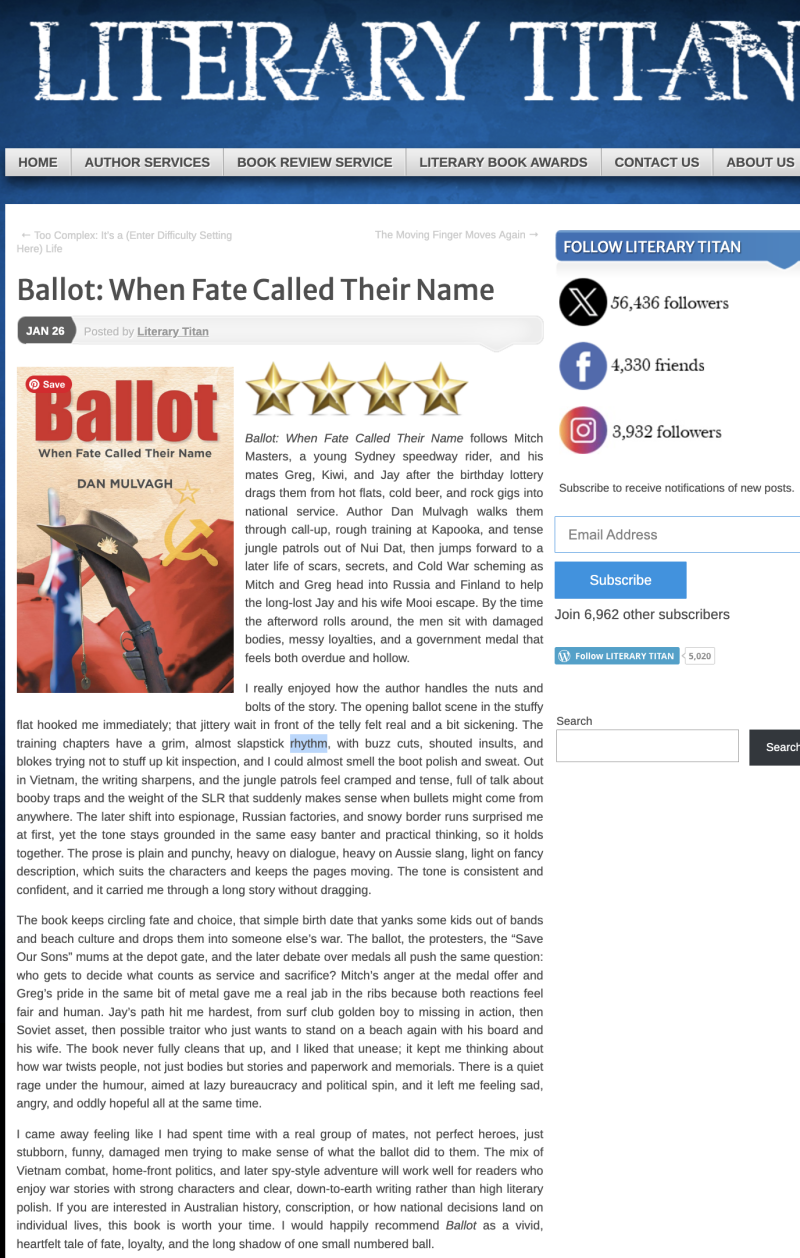
Ballot, When Fate Called Their Name
five stars
Mulvagh’s quietly powerful novel examines the randomness of conscription and the deep, enduring connections shaped by shared hardship in war. 1969. A birthday ballot decides who goes to war. For Mitch, Jay, Greg, and Kiwi, one number changes everything. Bound by chance and hardened by combat, they fight to survive a war they barely understand. Years later, rumours of missing prisoners and hidden truths surface, forcing them to confront what really happened—and what was never meant to be known.
Mulvagh explores the unsettling randomness of fate through the lens of conscription-era Australia. With clarity and restraint, he traces the transformation of his protagonists from civilians into soldiers, and beyond. The story’s emotional core lies in its portrayal of mateship: fragile, enduring, and shaped under pressure. Expanding beyond Vietnam, the author ventures into questions of memory, truth, and political silence. Replete with historical insight and quiet emotional force, the novel also probes the personal cost of national decisions, revealing how war reshapes identity, fractures certainty, and binds lives together in ways neither time nor distance can fully undo.
Recommended for readers interested in Vietnam War–era historical fiction that combines character-driven storytelling with broader political context.
Tina S
Bookview Review

Following is an official OnlineBookClub.org review of "Where the Truth was Buried" by Dan Mulvagh.]
5 out of 5 stars
Following is an official OnlineBookClub.org review of Where The Truth Was Buried. By Elizabeth Humberstone
I rate Dan Mulvagh's book, Where The Truth Was Buried, five out of five stars.
It is an exceptional read.
James Hamilton is a war orphan. In 1953, he was shipped from Cornwall, England, to Auckland, New Zealand. In 1989, he returned to Cornwall after he was bequeathed a seaside cottage from his late uncle Nat. His plan was to sell the cottage and return to New Zealand. While he was going through a desk, he found letters Nat had sent to the orphanage where he used to live. This discovery sparked James's desire to learn about his parents, Nat, and what happened during the war.
Mulvagh had written this book from multiple perspectives. One from James's view, trying to learn his history, and one from Richard (Dick) Slak. I found Dick's view particularly engaging. He struggles with the war and fulfilling the last wish of his dying friend. Dick wrestles with loss and guilt while still finding moments of happiness and humour.
I found the perspective changes quite jarring at times. From a feathered duvet and cotton sheets in Bathford, UK, to a convoy of medical vehicles carrying wounded soldiers speeding out of Cairo, Egypt. The descriptions of both environments and emotions were so vivid that I had to pause reading to get my bearings.
It is exceptionally well-edited, and I found no errors throughout the book. I cannot find any faults in this book;
I recommend this book to people interested in war stories and life in the aftermath of war. This book is fairly short and good for a quick read. However, that does not mean that it is a light read; this book has many dark and heavy topics.
"Your book 'Ballot' deserves extraordinary praise, and we are proud to acknowledge your hard work, dedication, and writing talent. Start telling the world that you're an award-winning author because we will be!" Thomas Anderson, Editor in Chief, Literary Titan
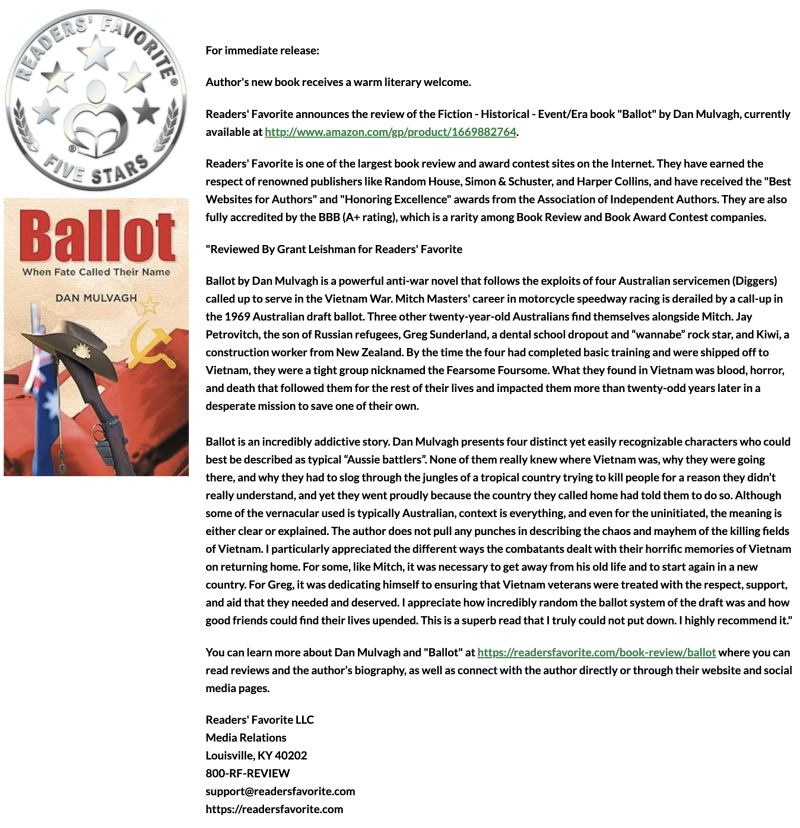
"Ballot is an incredibly addictive story." Grant Leisham, Readers Favorite
"I give this masterpiece a 5 out of 5." Charles Elavarasi, Online Book Club.

Ballot Nominated for Literary Titan Silver Award